


Text & photographs by Dr. Mahadeswara Swamy, Scientist
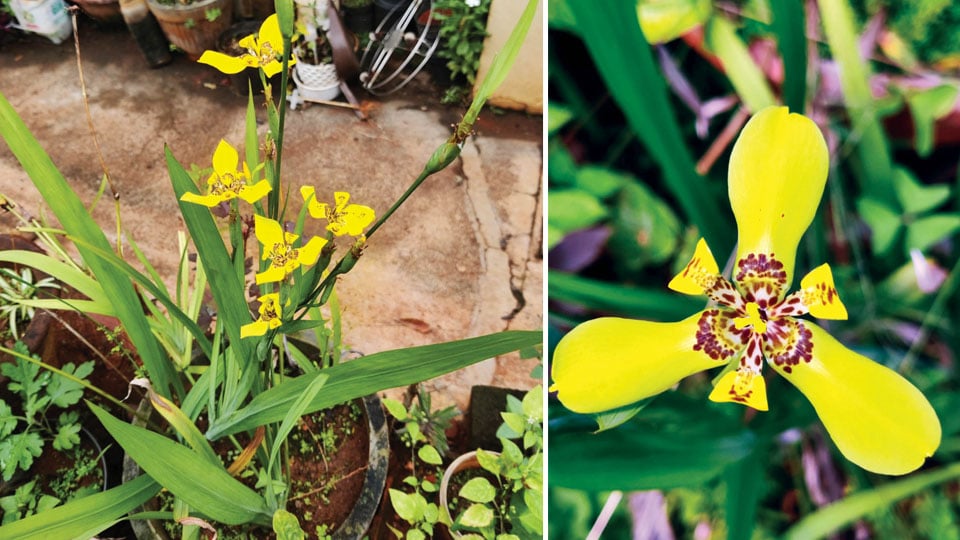
Iris is a general term for more than 250 species of flowering plants. A few among them are called Walking Irises. The name implies the plants walk. In fact they get the name from the propagation method. When the flowers fade plantlets (baby plants) develop on extended stems and become heavy as they grow older only to be pushed down to the ground. Then they root into the soil and grow as independent plants. The domino effect follows resulting in more adjoining area being colonised. This is how the Walking Iris plants “walk” through the landscape. Yellow Walking Iris is one such plant with flamboyant flowers. The plant is commonly called ‘Apostle Plant’ referring to 12 apostles, as some believe the plant needs twelve leaves before it blooms. It is also known as 'Fan Iris', 'Poor man's Orchid' besides 'Martinique trimezia'. It is also called "Hand of God" because of three flower petals. The scientific name is Trimezia steyermarkii (syn. Neomarica longifolia) belonging to Iridaceae family. Genus epithet 'Trimezia' is derived from Greek words 'tri' and 'meze', which mean 'three' and 'greater' respectively, a reference to the distinctive flowers, whose 3 outer segments are bigger than the inner ones. Species epithet 'steyermarkii' is in honour of American Botanist Julian Steyermark. Widely cultivated in the tropics and subtropics, the plant is native to warmer parts of Central and South America and West Indies.