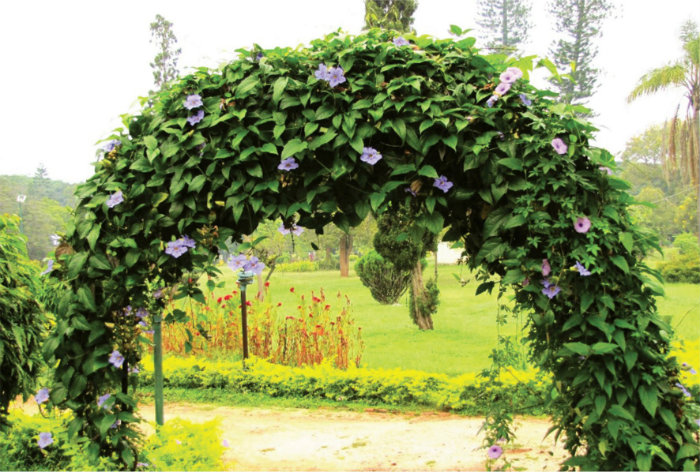


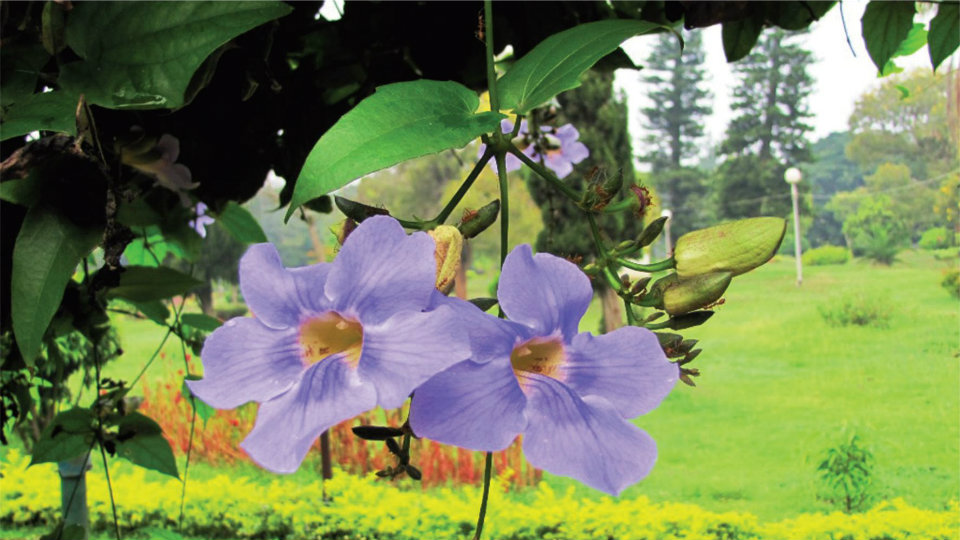
Climbers are an integral part of any garden. Perching on trees, resting on low roofs, high buildings, twining on arches, pergolas and trellises, they display dazzling beauty with decorative foliage and colourful blooms often with sweet fragrance. One of the prettiest climbers, which grows luxuriantly in Mysuru’s salubrious climate is “The Bengal Clock Vine.” The curious name ‘clock vine’ comes from the fact that it twines around a support in a clockwise direction. With gorgeously showy flowers and lush foliage, it is popular because of its easy culture. In my view, it is the best among the climbers and a choice addition to any garden. It is known by many other names such as “Bengal Trumpet”, “Bengal Clock vine”, “Indian Sky Flower”, “Sky Vine”, “Blue Trumpet Vine”, “Blue Sky Flower”, “Blue Thunbergia”; Hindi: Neel latha. The scientific name is “Thunbergia grandiflora” belonging to the family Acanthaceae. The genus ‘Thunbergia’ is named after Carl Peter Thunberg, a Swedish doctor who studied under Carl Linnaeus. The specific epithet is from the Latin words ‘grandis’ meaning “great” or “large” and ‘flora’ meaning “flower” in reference to the flowers which are large for the genus. It is native to West Bengal, North Eastern India, China, Nepal and Burma. The handsome Thunbergia grandiflora is a perennial evergreen plant. A rampant climber, the stems are hardy with woody stems. With its vigorous growth tendency, it has the spreading habit. A rapid grower, it needs support and the rope-like stems can reach to the top of large structures or even cover moderate-sized trees. The simple leaves are arranged in opposite or sub-opposite position on stems. They possess distinctive elongated heart shape varying from ovate to elliptical, often with slightly toothed margin, 10-20 cm long. They are dark green, leathery and softly hairy. The flowers are borne singly or in pendent racemes (drooping clusters). They are trumpet shaped, a little deeper, about 3” long, pale blue or white cup-like with pale yellow to cream blue striped centres. The fruit, which is called a capsule, is inconspicuous and not showy. There are two varieties: ‘Augusta’ - The most common variety. Flowers lavender blue to violet blue with yellow throats; ‘Alba’ - White flowers with a yellow throat. Another species of Thunbergia, which is closely related to and often mistaken for T. grandflora, is T. laurifolia, which produces pale mauve flowers. It is not so dense as T. grandiflora.