

By Sujata Rajpal
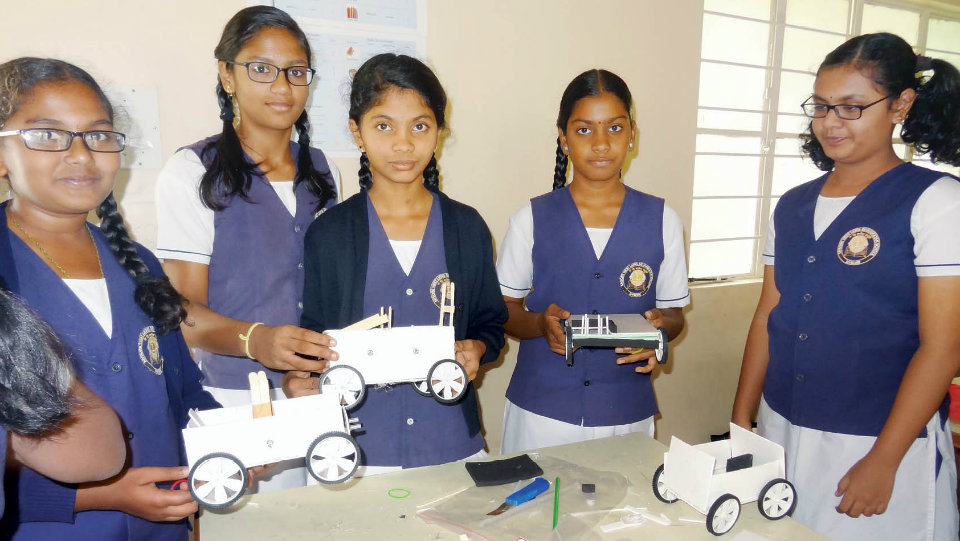
About 40-odd students of 8th grade assemble in a classroom and are making miniature cars out of sun board, toothpicks, rubber bands and other such material. Each vehicle is unique in itself — single seater with no boot space, family passenger car and some resemble a big tow truck. Ask the students what they are doing and they reply in unison, ‘We are making a car that doesn’t crash.’ The students are given an assortment of raw material to choose from to manufacture the car within a fixed budget; it is up to them how they want their vehicle to look like. Mind you, it is no craft class, it is the Tinkering Lab. I was curious to see the Tinkering Lab live when I heard of the concept. On a busy Monday morning at 11.30, I find myself attending an 80 min Tinkering Lab session at Lions West Sevaniketan School in Gokulam. After the car is manufactured, an egg is placed in place of the driver and the car is ready for the test drive. The students are given a problem that the car shouldn’t crash. They have to find a solution however they want to. ‘I don’t miss school on Mondays even if I am sick because we have tinkering lab on Mondays,’ says Samudyatha, an enthusiastic 8th grader. Started in 2014 by two ex-techies from Namma Mysuru, with tinkering as a medium, Science Ashram aims to revolutionise the education system with curriculum that encompasses STEM education and beyond. Problems that mimic real-world scenarios empower children with necessary skills and competence to face challenges in the future thus preparing them for life beyond the classroom. Even adults would enjoy dabbling in it. It aims at reorienting education from knowledge acquisition to skill mastery thus granting the students the freedom to innovate and take decisions. ‘It is a revolutionary concept aimed at making our children think out of the box. We introduced the Tinkering Labs in 2018 for the students of 6th, 7th and 8th grades and the newly gained confidence in the students is conspicuous,’ beams Ln. K.S. Gururaja, the President of the School. ‘The entire cost of the project is borne by the school. It is completely free for the children.’