
By Dr. Padmavathi Narasimhan
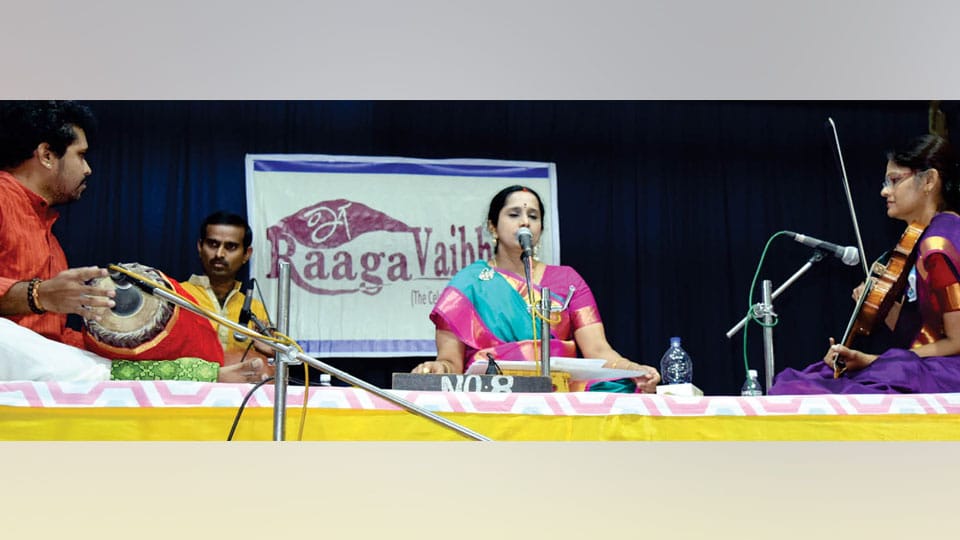
On the 21st of April, popular musician and Harikatha exponent Vishakha Hari gave a musical discourse at Mysore Vasudevacharya Bhavan, Mysuru. The event was organised by Raga Vaibhava. Vishakha was accompanied by Charulata Ramanujam on violin, Arjun Ganesh on mridanga and S. Manjunath on ghata. The three-hour event enchanted the audience who were glued to their seats till the end. ‘Ramayana’ as a tribute to her Guru Lalgudi G. Jayaraman was the topic of the day and Vishakha covered the story from the very beginning where Sage Valmiki asks Rama ‘Konvasmin Sampratam Loke gunavan kascha veeryavan’ meaning who is the one in this world who is handsome, known for his valour, kind, who always follows Dharma and is truthful, who possesses good character, is devoid of jealousy, good in art and at his heart? Vishakha extolled the virtues of Rama, attributing them to her Guru and said Jayaraman owned all these qualities of Rama and lived every moment of his life for people as Rama did. Just as Rama had his bow in his hand, Jayaraman had his bow (pun) in his hand and enthralled the world with it. (This statement caused many elderly eyebrows in the hall to raise, as Vishakha’s opening of her recital with Tyagaraja’s ‘Samanamevaru’ in Kharaharapriya, which goes to explain who could be equal to Rama was somewhat ironic). Vishakha also highlighted Lalgudi’s virtue as a trend setter. Previously it was enough if the violinist as an accompanist knew the swaras to follow. But Lalgudi was not satisfied with this. He insisted that the violinist and also the mridangist should know the mood of the composer. He was a musician who saw music (sangeeta) in lyrics (sahitya) unlike other musicians who see sahitya in sangeetha. And measure was like salt to him. He would not overdo anything — be it birgas or sangatis as Bhava was most important to him. Lalgudi also gave prominence to the sahitya and the right split in the lyrics. Why the right split in sahitya is important was explained humorously by Vishakha illustrating ‘Karamuna Shara Kodanda kanti’ in ‘Nannupalimpa’ Kriti, which is wrongly split by many as ‘Karamuna Sharako Dandapani’ which would change the entire meaning as the composition is on Rama who is Kodanda Pani and not on Subramanya who is Dandapani. Lalgudi learned Telugu to understand the mood and sahitya of the composition. More than 50-60 compositions of Tyagaraja which were not on the concert platform like ‘Enta muddu (Bindumalini) and Nadaloludai (Kalyana vasanta) were brought to the fore by Lalgudi. He would grammatically analyse each composition and improvise on the sangatis in each one of them. That is why his violin was known to ‘sing.’ The swaras he played were pleasing to the mind and soothing to the ears. Every syllable was loaded with melody.