

By N. Niranjan Nikam
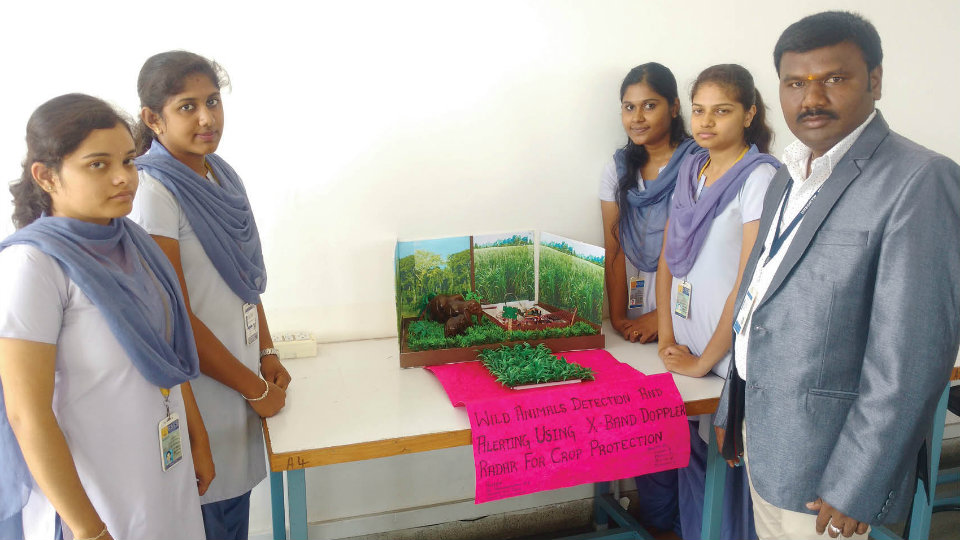
She was all of ten years when she saw her grandfather coming in contact with the electric fence and dying of shock. The dark memory stayed with her for years but she could not imagine that one day she would be doing engineering and motivating her team to take up a project to save lives of farmers from electric shock. “I come from Amble in T. Narasipur taluk. We have farm land and it is fenced by electric fence to protect the crops from wild animals. I saw my grandfather dying because he was not aware that the power had been switched on by the lineman during the change of shifts. He just touched the wire and died. I shared this experience with my classmates and with the help of our guide we came up with this project titled ‘Wild animal detection and alerting using X-Band Doppler radar for crop protection,’” said M. Manasa, a student of Telecommunication Engineering from GSSS Institute of Engineering and Technology for Women (GSSSIETW), Mysuru, even as her teammates R. Chaitra, K. Sanjana and L. Thejaswini, all students of 8th semester, nod their heads in unison, sharing their experiences with Star of Mysore. “Radars are related to telecommunication and that is why I suggested the girls to take up this project. There are 250 Engineering Colleges under Visvesvaraya Technological University (VTU) and it has four regions — Mysuru, Belagavi, Kalaburagi and Bengaluru. Our college is the only one in Mysuru region offering this course which means only girls can take up Telecommunication Engineering that is accredited by National Board of Accreditation,” said Dr. B.D. Parameshachari, Professor and Head, Department of Telecommunication Engineering. According to a recent research, about 48 per cent of crops are lost due to wild animal attacks on farm fields. Due to this, farmers face lot of problems. In order to overcome this, some old methods like torch lights and lantern, display of dead body parts, mounting of plastic paper on wooded sticks, lighting of fires and tape recorders were used to scare away the wild animals, said Chaitra. Another method that is widely used in the farm land is the electric fence. “The cost of fencing one acre of land is Rs.20,000. In summer the shocks will be more and in winter it will be less. Not only is this more expensive but most of the farmers cannot afford it. Besides fire hazards are more with electric fence,” said Thejaswini. “The electric shocks not only result in loss of animal life but also are dangerous to humans. In villages, the power cut timings are introduced like in cities and farmers have a misconception that there will be no power according to the shift power cut, just as Manasa’s grandfather thought and lost his life years ago,” said Sanjana. If solar fences are used, then during winter times, the charging takes time due to less sunlight. Hence, there is no proper electricity passing through the fence and there will be no electric shock, which renders the solar fences useless, said the students.