

By Dr. S.A. Mohan Krishna, Amateur Astronomer
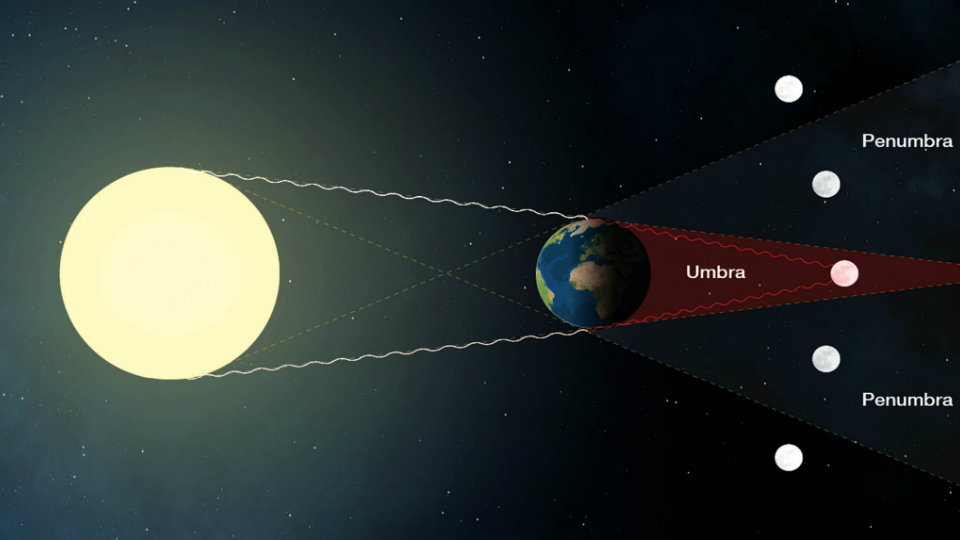
None can forget the mesmerising Supermoon, Bloodmoon, Total Lunar Eclipse that occurred on January 31 this year! This astronomical occurrence was memorable and millions witnessed this spectacular spectacle. Analogously, on July 27 and 28, Indians are really privileged to witness a regular ‘Total Lunar Eclipse.’ This eclipse will be visible in the region covering Europe, Asia, Australia, Africa, Northern and Southern America, Indian, Atlantic and Pacific oceans. This eclipse can be seen from all parts of India. This Lunar Eclipse is regarded as the longest total lunar eclipse of this century with totality duration of 1 hour 43 minutes. In simple words, Lunar Eclipse is the passage of the Moon through Earth’s shadow. Lunar Eclipses, which may be total or partial, can occur only at full moon when Sun, Earth and Moon are in line. As the Sun is an extended light source, Earth’s shadow has two components — a dark, central Umbra, where the Sun is completely obscured, and a lighter outer Penumbra, within which the obscuration is partial. During a Lunar Eclipse, the Moon passes first through the Penumbra, taking about an hour, moving eastward by its own diameter in this time, to reach the western edge of the Umbra. During the Penumbral phase, the light of the full moon is only slightly reduced. A Lunar Eclipse occurs when the Moon passes through the Umbral region of the Earth’s shadow and becomes imperceptible. Lunar Eclipse is discernible from a large part of the Earth. Lunar Eclipses usually precede or follow Solar Eclipses by a fortnight. During a total Eclipse of the Moon, the range of shading and the intensity of colour vary enormously. No two Lunar Eclipses are ever quite the same, and although some dismiss them as of less interest than Solar Eclipses —particularly total Solar Eclipses, where the events centred on totality occur rapidly, in contrast with more stately progress of a Lunar Eclipse — they are fascinating to observe. Lunar Eclipses also have the advantage of being visible from the entire hemisphere of the Earth where the Moon is above the horizon, rather than being most impressive along a narrow track. The main difference from one event to another is the degree to which the totally eclipsed Moon is darkened and how colourful it might be. The complete details of Total Eclipse of the Moon that can be seen from Mysuru are given below in Indian Standard Time (IST): The duration of the Total Lunar Eclipse visible on July 27 - 28 is 6 hours 14 minutes. The total eclipse will commence at 1:00 am on July 28 and terminates by 2:43 am on July 28. The greatest phase of the eclipse will eventuate at 2:43 am on July 28. The magnitude of the total eclipse of the Moon is 1.609. On July 27, the red planet Mars will have a closer encounter with Earth, which implies that, Sun and Mars will lie opposite to each other. Following first contact, the Moon’s more easterly limb will show a growing dark “nick” as it begins to enter the Umbra more deeply. At a Total Lunar Eclipse, Moon takes about an hour to become completely immersed in the Umbra. To begin with, there is little to see beyond a darkening of part of the Moon, but as the eclipsed portion increases, some colour may become evident. The curved edge of the Umbra may show a slight blue fringe. Refraction of sunlight — particularly at the red end of the spectrum — through Earth’s atmosphere means that the Umbra is not completely dark. Consequently, the Moon does not usually disappear from view; instead, it is dimmed and often takes on a reddish colour, which becomes increasingly apparent as the Umbral phase advances. The diameter of Earth’s Umbra is thought by some to change in response to solar activity, perhaps decreasing at solar maximum as the upper atmosphere becomes slightly more extended in response to increased ultraviolet and X-Ray emissions. Many observers try to measure the precise extent of the Umbra during eclipses by timing the passage of its edge across identifiable Lunar features such as craters. Unless a Lunar Eclipse is very dark, it is usually quite easy to make out the dark Maria, contrasting with the brighter, cratered highlands, with the naked eye. At totality, the Moon — completely immersed in shadow — normally shows red, orange and yellow colours, often with some gradation. Those parts of the Moon closer to the edge of the Umbra often appear somewhat brighter and more yellowish than those toward the centre, which are redder. Sunlight diffusing through the Earth’s atmosphere bathes the Moon in a dull glow that reduces it to about one ten-thousandth the normal brightness of the full Moon. The same principle causes the early-evening sky to remain relatively bright, even though the Sun is below the horizon. The shadow’s darkness varies with the amount of cloud, dust and pollution that is suspended in the Earth’s atmosphere at the time of the Eclipse. Occasionally, the obscuration is sufficiently dense to make the Moon disappear, while at other times, the shadow imparts only a pale rusty hue to the Moon. There is absolutely no harm in witnessing this gorgeous astronomical spectacle and could be clearly witnessed by using a reflecting telescope or astral binoculars. The duration of totality in a Lunar Eclipse depends on how nearly centrally the Moon passes through the Umbra; a central passage gives a maximum of 1 hour 47 minutes. During totality, any lighter border on the Moon will appear to move gradually round from the westerly to the easterly limb. Totality ends when the Moon’s easterly limb re-emerges into sunlight, and over the next hour or so the full moon exits the Umbra to regain its usual brilliance, thereafter clearing the Penumbra.