

Text & photographs by Dr. Mahadeswara Swamy, Scientist
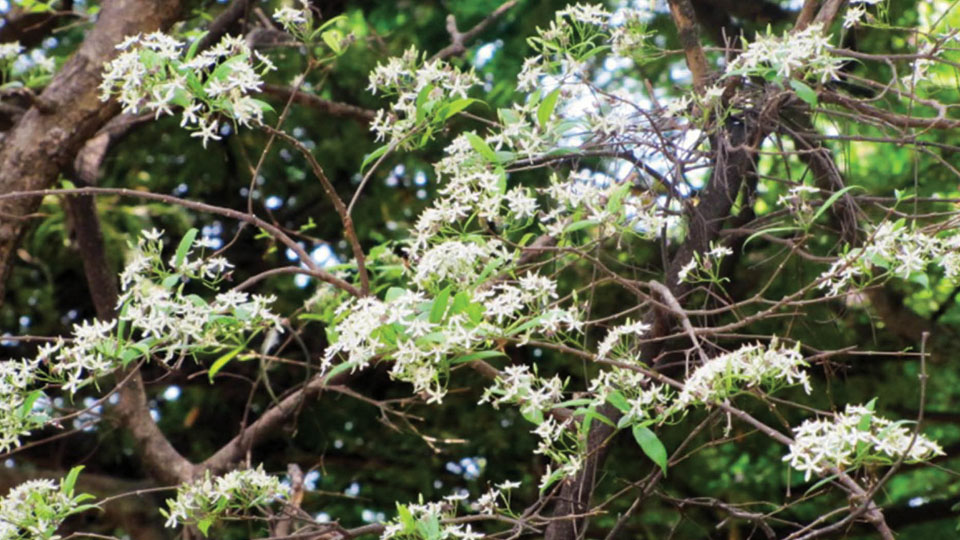
There are trees known as multipurpose trees (MPT) used for different purposes. A few provide timber for commercial purposes but endowed with medicinal properties besides being ornamental. “The Ivory Wood” tree, used for making Channapatna toys, belongs to this category. The wood turns to ivory colour with age. That is why the name. A tree from the wild introduced to urban environs, it is one of the most beautiful avenue trees of Mysuru and attracts passersby during summer months with its handsome blooms of white, star-shaped vanilla scented showy flowers. Other common names are ‘Sweet Indrajao’, ‘Pala’, ‘Dyer’s Oleander’ or ‘Dyer’s Indigo’. Vernacular names are — Kannada: Beppale, Alemara, Kodesige, Ajamara, Kodamurki; Tamil: Vetpalai, Irumpalai; Telugu: Repala, Tedlapala, Jediapala; Malayalam: Mayilampaala, Nettampala; Hindi: Dudhi, Indrajau; Sanskrit: Krishna Katuja. The scientific name is Wrightia tinctoria, belonging to the family Apocyanaeceae. The generic name ‘Wrightia’ is in honour of William Wright, the 19th Century Scottish Physician and Botanist. The specific name “tinctoria” refers to “tinct” in Latin meaning “dyed, tinged”. The tree is native to India, Sri Lanka and Myanmar. It is common in deciduous forests of North West and Central India and Southern Peninsula. “Wrightia tinctoria” is a small or medium-sized deciduous tree with slender cord-like branches often attaining a height of 25 ft! The tree exudes a cream coloured latex. The bark is light grey, scaly and smooth but becomes fissured when old. The leaves are simple, in opposite pairs, softly downy with a very short stalk, elliptic, ovate with an acute or oblong base with prominent lateral nerves (5-10 pairs). The flowers are arranged in sloppy terminal cymes, appear along with new leaves. They are fragrant, white, about 3 cm wide with twisty petals. Sepals are glabrous, glandular inside, oblong with membranous margins. The petals salver-shaped with a short corolla tube with an appendage (corona) of numerous linear scales around the stamens, which form a cone at the centre. The ovary 2 carpelled, free, many ovuled, usually with a toothed basal ring. Fruit technically called a pair of cylindrical follicle, very long, tapering at both ends and joined at the tips (special characteristic) contains seeds appended with hairs (basal coma).