

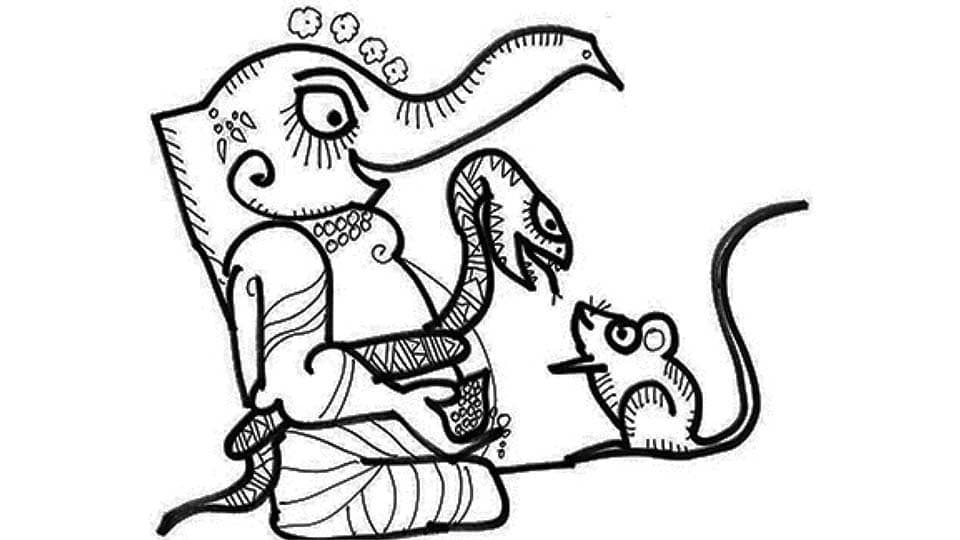
Ganesha, the elephant-headed God of Hindus, is renowned for his huge belly, which is a symbol of affluence and abundance. His elephant head evokes power. His vehicle, or vahana, is a tiny mouse, which is known to overcome barriers, and find its way into storehouses, find food and hoard it. Rats are notorious to catch. But few notice that around his belly is a snake. Snakes eat rats. In Ganesha’s hand is a sweetmeat called modaka, shaped like a bag of coins. Ganesha’s rat does not seem to be interested in nibbling a bit of that food.
So, we have before us an image of affluence and abundance indicated by the elephant-head and the potbelly. But we also have the image of contentment: the snake is not eating the rat and the rat is not eating the sweet. Ganesha seems to offer the moneybag shaped sweetmeat to his devotees with one hand. The other hand’s palm faces outwards and points upwards, which means, do not be afraid. Ganesha is thus a God who provides and protects, while being affluent, powerful and content. He embodies the Hindu ideal of a yajaman.