

Mysore/Mysuru: Renowned astronomer Dr. B.S. Shylaja, Visiting Scientist and former Director of the Jawaharlal Nehru Planetarium, Bengaluru, emphasised the importance of advanced spectroscopy in the study of sunlight and stellar phenomena.
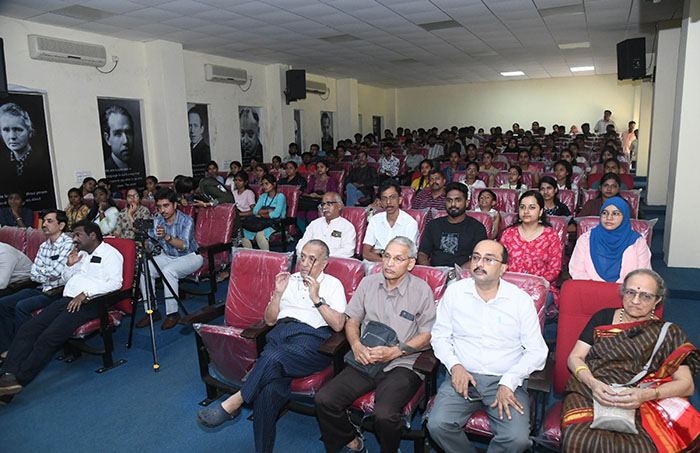
Delivering a special lecture titled ‘Spectroscopy — A Tool to Understand the Inaccessible’ at the Einstein Auditorium of the Department of Physics, Manasagangothri, University of Mysore (UoM), she explained that although sunlight appears white, it is actually composed of seven colours. Spectroscopy, she noted, is the key to studying this scattering of light.
The lecture was organised by the Department of Physics in collaboration with the Cosmology Education and Research Training Centre (COSMOS-Mysuru) of the Indian Institute of Astrophysics (IIA). Dr. Shylaja introduced students to the fascinating world of spectroscopy and its applications in astrophysics.
Pointing out that light is the only information available to scientists from celestial bodies, she said, it must be used to decode their secrets. “Spectroscopy provides insights into the temperature, chemical composition and surrounding environment of stars, and a detailed analysis can even reveal their age.”
Dr. Shylaja explained that when spectroscopy is used along with telescopes, scientists can analyse starlight to identify the elements present in stars, measure their temperatures and study their motion.
She also demonstrated how simple formulas can be applied to estimate the temperatures of stars and planets. She noted that the Sun’s temperature is about 5,000 to 6,000 Kelvin, while some stars can reach temperatures of up to 10,000 Kelvin. Among the planets in the Solar System, Venus has the highest surface temperature.
The lecture concluded with a hands-on session using the online stellar spectra resource from the SDSS survey, where students estimated temperature, spectral type and approximate chemical composition based on Planck’s black body formulation.
Prof. A.P. Gnanaprakash, Head of the Department of Physics, along with Prof. M.S. Chandrashekar, Prof. H.P. Ravikumar, Prof. M. Mahendra and several others attended the programme.
Star gazing sessions at UoM suspended
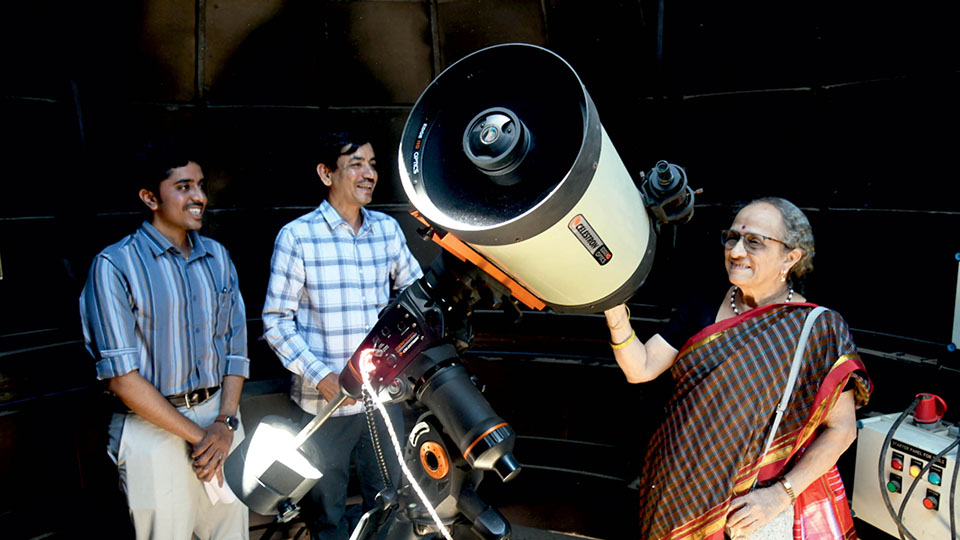
The weekly opportunity for star-gazing through telescopes at the Department of Physics, Manasagangothri, University of Mysore (UoM), has been temporarily suspended.
According to Prof. A.P. Gnanaprakash, Head of the Department, the decision was taken in view of declining public interest and the academic commitments of students preparing for examinations.
Until recently, the Department had been conducting telescope-based sky observation sessions once every week. Prof. Gnanaprakash clarified that the suspension is only temporary and the programme may resume once conditions become favourable.