


By Dr. S.A. Mohan Krishna, Amateur Astronomer
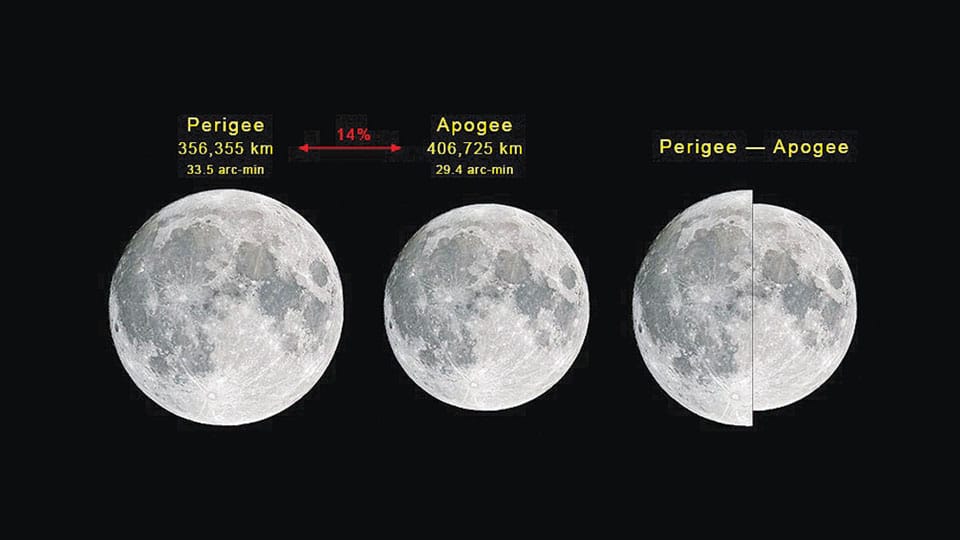
Tonight (Mar.21), Indians will be privileged to witness the spectacular, biggest, resplendent, and brightest full Moon as it will pass by Earth at a distance of 3,58,246 kms. This is known as lunar perigee and a normal lunar perigee averaging a distance of 357,492 kms happens once every orbital period. This event can be referred to as “Supermoon.” The term “Supermoon” was coined by astrologer Richard Nolle. He generally describes Supermoon as perigee-syzygy — a new or full Moon (syzygy) which occurs with the Moon at or near (within 90%) its closest approach to Earth (perigee) in a given orbit. In short, Earth, Moon and Sun are all in a line, with Moon in its nearest approach to Earth.