

Mysore Literary Association, founded in 2016, aims to promote literary activities and conduct festivals to enrich English studies in the royal city. It has so far held numerous literary events including seven Mysuru Literary Fests under the Chairmanship of its Founder-President Prof. K.C. Belliappa, who is also the former Vice-Chancellor of Rajiv Gandhi University, Arunachal Pradesh.
Mysore/Mysuru: With a population of five million in 1900, Mysore was the third-largest Princely State in India, and its Maharajas ranked among the most powerful political figures of the time, said Dr. Chandan Gowda, Dean of the School of Liberal Arts at Vidyashilp University.
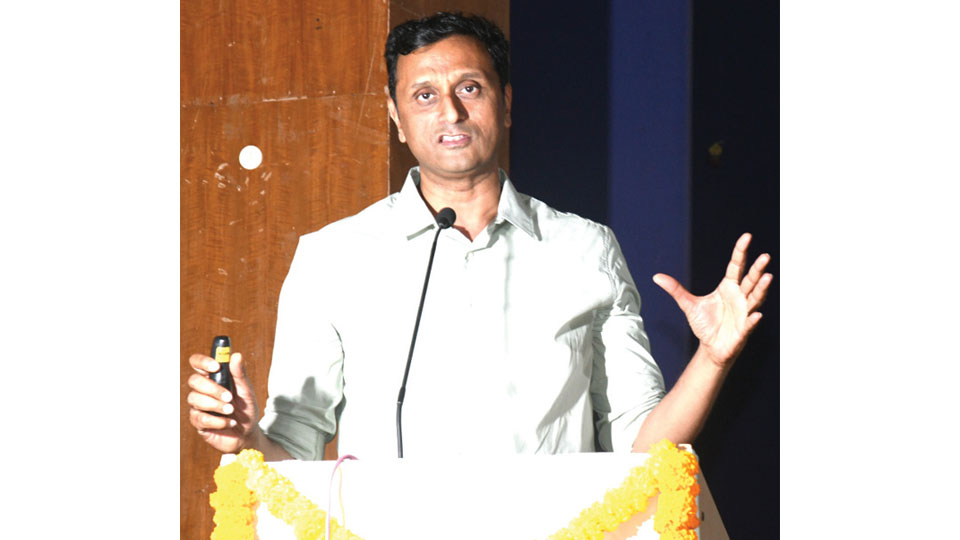
He was delivering a talk on ‘Romancing Development: The Mysore Episode’ at the Seventh Edition of the Mysuru Literary Fest-2026 held yesterday at Maharaja’s College Centenary Hall, organised by Mysore Literary Association.
Dr. Gowda traced how Mysore emerged as one of South Asia’s most progressive, urbanised and modernised regions by the late 19th and early 20th centuries, outpacing many territories under British colonial rule.
He described the State’s development vision as a blend of diverse intellectual influences, including the neo-mercantilism of Friedrich List, social developmentalism and early humanitarian thought.
“The Maharajas, along with their ministers, dewans and planners, prioritised industrial growth, education and social infrastructure, a commitment reflected in contemporary Indian and foreign writings of the period,” he noted.
Presenting a critical analysis of modernisation in Mysore between 1881 and 1947, during its period of indirect rule, Dr. Gowda cited the political scientist James Manor, who noted that Mysore’s rulers were seen as heroes by Indian nationalists and as evidence of Indians’ capacity for effective self-governance.
He also referred to Mahatma Gandhi’s 1894 address at the Natal Legislative Assembly (Legislative body of the British Colony of Natal, now part of South Africa), where Gandhi praised Mysore’s representative Parliament, the Mysore Assembly, as closely modelled on the British Parliament.
In 1917, Dewan M. Visvesvaraya similarly stressed that Mysore must learn from progressive nations to shape its future, he added.