

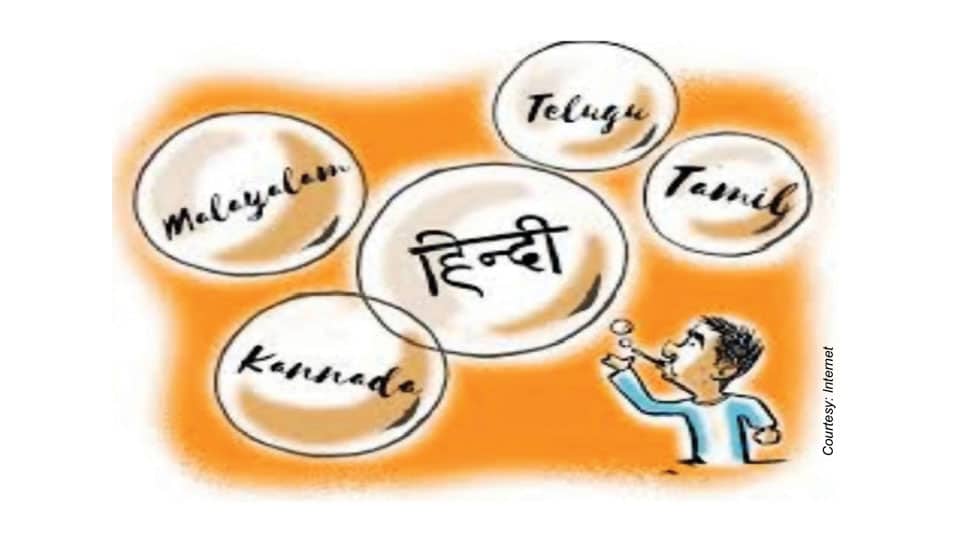
While English language is a legacy that the land’s literati owe to the British rule for several decades and Hindi is the tongue of about one-third of the country’s people, all the languages spoken by its masses reportedly number 1,562, making India unsurpassed by any country across the world for its multilingual diaspora. Classical language status has been conferred on six languages namely, Kannada (2008), Tamil (2004), Telugu (2008), Malayalam (2013), Odiya (2014) and Sanskrit (2005), based on their antiquity, although the order of dates shown in brackets wrongly places Sanskrit in second place. If the terms figuring in virtually all these languages and the variation in their spoken style, both of which are known to be diverse even in their respective exclusive regions, such as Karnataka, the number of tongues spoken by the masses, particularly for verbal communication, far exceeds the number listed by the Mysuru-based Central Institute of Indian Languages (CIIL). The stock of literature in the country’s languages, including those without script, such as Tulu, Konkani and Kodava is a rich source of its cultural history of more than 20 centuries.
Scholars are of the view that all the languages of India’s Southern States as well as Odiya and Burmese have drawn heavily from Brahmi script for creating the literature in their respective languages. India’s urbanities, thanks to intermingling of people of many regions, are known to be freely using at least three languages while interacting among them. Finding residents of cities with familiarity of five languages, including English, is no big deal.