

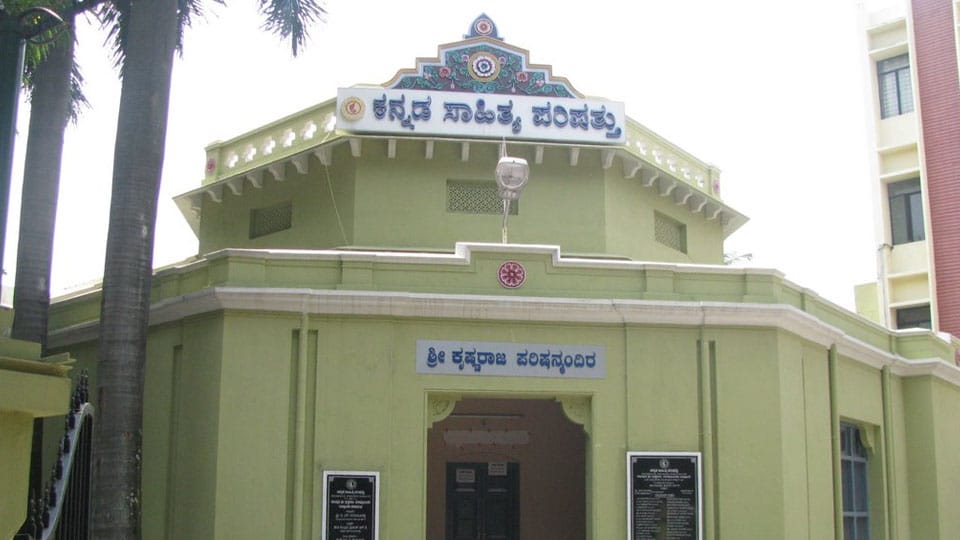
Kannada Sahitya Parishat has a history of its own and has passed through various stages to come to its own as we see it today. An organisation called Sampadabhyudaya Samaja organised a conference in 1914 and its annual conference discussed the issues relating to the development of Kannada. In that conference it was decided that to help writers in Karnataka language, an independent Parishat should come into existence and further it was decided that Sampadabhyudaya Samaja should send its recommendation to the Government. Having this in view, it was decided to request all prominent persons on 31.10.1914 to be at Bengaluru. The agenda was to discuss reforms of Karnataka language and development of books in Karnataka language. To help this and to chalk out a programme, a Sub-Committee was constituted. The Committee consisted of M. Shama Rao, Karpura Srinivasa Rao and P. S. Achuta Rao. At the request of the Sub-Committee, many prominent Kannadigas sent their opinions and 31 such writings were collected. These were placed and discussed at a meeting held at Bengaluru Government High School. This meeting was held on 3.5.1915. This was the first Annual Conference of Kannada Sahitya Parishat. Representatives came from Dharwad, Belgaum, Uttara Kannada, Bombay, Bellary, Dakshina Kannada and many districts of Mysuru State. Many newspapers also sent their representatives to cover the event and give wide publicity to the cause of the Parishat. The first conference was held under the Presidentship of Rajamantra Praveena V. Nanjundayya, who was elected unanimously. The conference was held for four days. In course of time, K. P. Puttanna Chetty and Karpura Srinivasa Rao became Presidents. On the third day of the conference, it was decided after a lot of deliberations to formulate the Constitution, rules and regulations. The following decisions were taken:
- The Sangha should be named Karnataka Sahitya Parishat and it headquarters should be in Bengaluru.
- Its work was to get books written on grammar, history of Kannada language, compiling dictionaries and technical terms for the use of writers.
- Translation from other languages.
- Publication of ancient good books.
- Collect history and its publication.
- Establishment of a Museum of old objects.
- Encouragement to publication of Kannada newspapers.
- Arranging lectures by eminent persons of Karnataka in Kannada.
- Publication of independent Kannada works.
- Purchase of Kannada books in bulk to help the Kannada writers.
- Encouraging authors by awarding titles (prashastis) and giving remunerations.
- Giving scholarships to expert researchers in Kannada.
- To establish Kannada libraries and reading rooms.
- Arranging lectures in Kannada by eminent persons.